
Droste Group Leadership Competency Model™
Define what great leadership looks like. Then build it consistently.
Most organizations have leadership expectations.
Far fewer have a clear, practical definition of the specific behaviors leaders need to demonstrate at different levels of responsibility—and a system for developing, reinforcing, and measuring them.
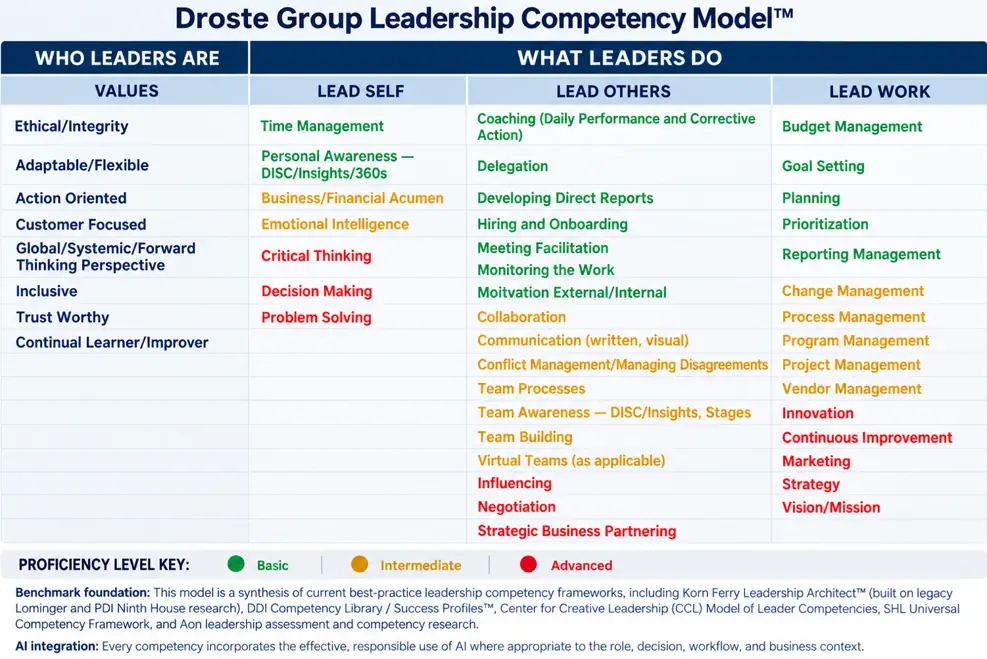
The Droste Group Leadership Competency Model™ provides that foundation. It defines leadership across four dimensions:
Who Leaders Are
The values and attributes that shape how leaders show up.
Lead Self
The capabilities leaders need to manage themselves, think effectively, make sound decisions, and continuously improve.
Lead Others
The capabilities required to coach, communicate, influence, develop talent, build teams, and create accountability.
Lead Work
The business disciplines leaders use to translate strategy into priorities, plans, processes, execution, and results.
The result is a leadership model that is clear enough to understand, practical enough to use, and comprehensive enough to support leadership across the organization.
Each Competency Requires a Different Effort for Mastery—and is Used to Different Degrees Depending on the Level of Leadership
One of the weaknesses of many competency models is that they treat every capability equally important for every leader—and takes an equal amount of effort to master. That isn’t how organizations actually work.
The Droste Group Leadership Competency Model™ distinguishes among:
- Basic — foundational capabilities are usually mastered more quickly and used fully by new leaders, although used to some degree throughout a leader’s career regardless of how senior.
- Intermediate — more complex capabilities taking longer to master, usually developed and used and used fully by more experienced leaders, although can be developed and used by new leaders as applicable, and used to some degree throughout a leader’s career regardless of how senior.
- Advanced — complex capabilities taking the most effort to master, usually developed and used fully by senior-level leaders, although can be developed and used by less experienced leaders as applicable.
This allows organizations to create a more realistic leadership progression. A frontline, mid-level, senior leader, and executive should not necessarily demonstrate every competency at exactly the same level of proficiency. And each competency at each level requires a different amount of effort to master. The model can therefore be customized to define what effective leadership looks like by level and role.
AI is Integrated Throughout the Model
AI is changing leadership. But we don’t believe the answer is simply adding an isolated “AI competency” to an otherwise traditional leadership model. AI increasingly affects how leaders:
- Analyze information
- Make decisions
- Solve problems
- Communicate
- Coach employees
- Plan work
- Identify risk
- Improve processes
- Develop strategy
- Execute
For that reason, AI integration is embedded throughout the Droste Group Leadership Competency Model™ wherever it is appropriate to the role, decision, workflow, and business context.
For example:
- A leader demonstrating Critical Thinking should be able to evaluate AI-generated information rather than simply accept it.
- A leader demonstrating Decision Making should understand how to use AI to improve analysis while retaining human judgment and accountability.
- A leader demonstrating Coaching may use AI to prepare for conversations or identify patterns while preserving the human relationship at the center of effective coaching.
- A leader responsible for Planning, Process Management, Strategy, or Continuous Improvement should increasingly understand where AI can improve speed, insight, productivity, or execution.
The objective isn’t AI adoption for its own sake. The objective is better leadership and better business performance.
Leadership Development Works Better When Everyone Is Developing Toward the Same Definition of Leadership.
Many organizations invest significantly in leadership development but still struggle with inconsistent leadership behavior. One business unit emphasizes coaching. Another emphasizes accountability. One manager defines strong leadership one way. Another defines it differently.
Training programs may be excellent individually, but without a common leadership architecture, development can become a collection of disconnected activities.
The Droste Group Leadership Competency Model™ helps organizations create the connection.
It provides a common language for:
- Leadership development
- Executive and manager coaching
- Performance management
- Talent assessment
- Selection and promotion
- Succession planning
- Individual development plans
- Team development
- Career pathways
- Leadership expectations
- Organizational culture
- Leadership execution
Instead of asking leaders simply to ‘be better leaders,’ organizations can define the specific behaviors that matter and reinforce them consistently.
One Leadership Language. Across the Organization.
When leadership expectations are clear, organizations can create greater consistency across the employee lifecycle. Hire against it. Assess against it. Develop against it. Coach against it. Promote against it. Measure against it.
That creates something leadership development programs often lack: continuity. And continuity makes it much easier to turn leadership development into leadership execution.
From Competency Model to Leadership Execution
A competency model only creates value if leaders actually use it. That’s why Droste onnects leadership competencies to our Leadership Execution System™.
We help organizations translate selected competencies into observable leadership behaviors and then reinforce those behaviors through:
Development → Application → Coaching → Manager Reinforcement → Accountability → Measurement
Instead of ending development when the workshop ends, organizations can continue reinforcing what leaders are expected to do differently. And that creates a much more important conversation:
Not simply,
“Did they complete the training?”
but:
“Are our leaders actually leading differently?”
And eventually:
“Is that difference improving organizational performance?”
Your Organization Doesn't Have to Use the Model Exactly as It Is
The model can serve as a comprehensive starting point. For many organizations, however, the greater value comes from tailoring it. Droste can work with your leadership team, HR, Talent, L&D, and business leaders to identify:
- Which competencies matter most to your strategy
- Which behaviors define each competency
- What should be expected at different leadership levels
- Which competencies are foundational versus differentiating
- How they should appear in selection, development, coaching, performance, and succession
- How AI changes the application of those competencies
- How leadership behavior will be reinforced and measured
The goal isn’t to create the largest competency model. It’s to create the right leadership model for your organization—and make it part of how leadership actually happens.
Want to Build or Strengthen Your Leadership Competency Model?
Whether you’re creating a leadership model for the first time, updating an existing model, integrating AI into your leadership expectations, or connecting competencies to a broader leadership-development strategy, we can help.
Let’s identify the leadership capabilities your organization needs—and turn them into behaviors your leaders can actually execute.